Vu lan 2025 - xe bus
👉 Mẫu đăng ký ở cuối trang này (link đã đóng) Tu viện Liên Tâm có
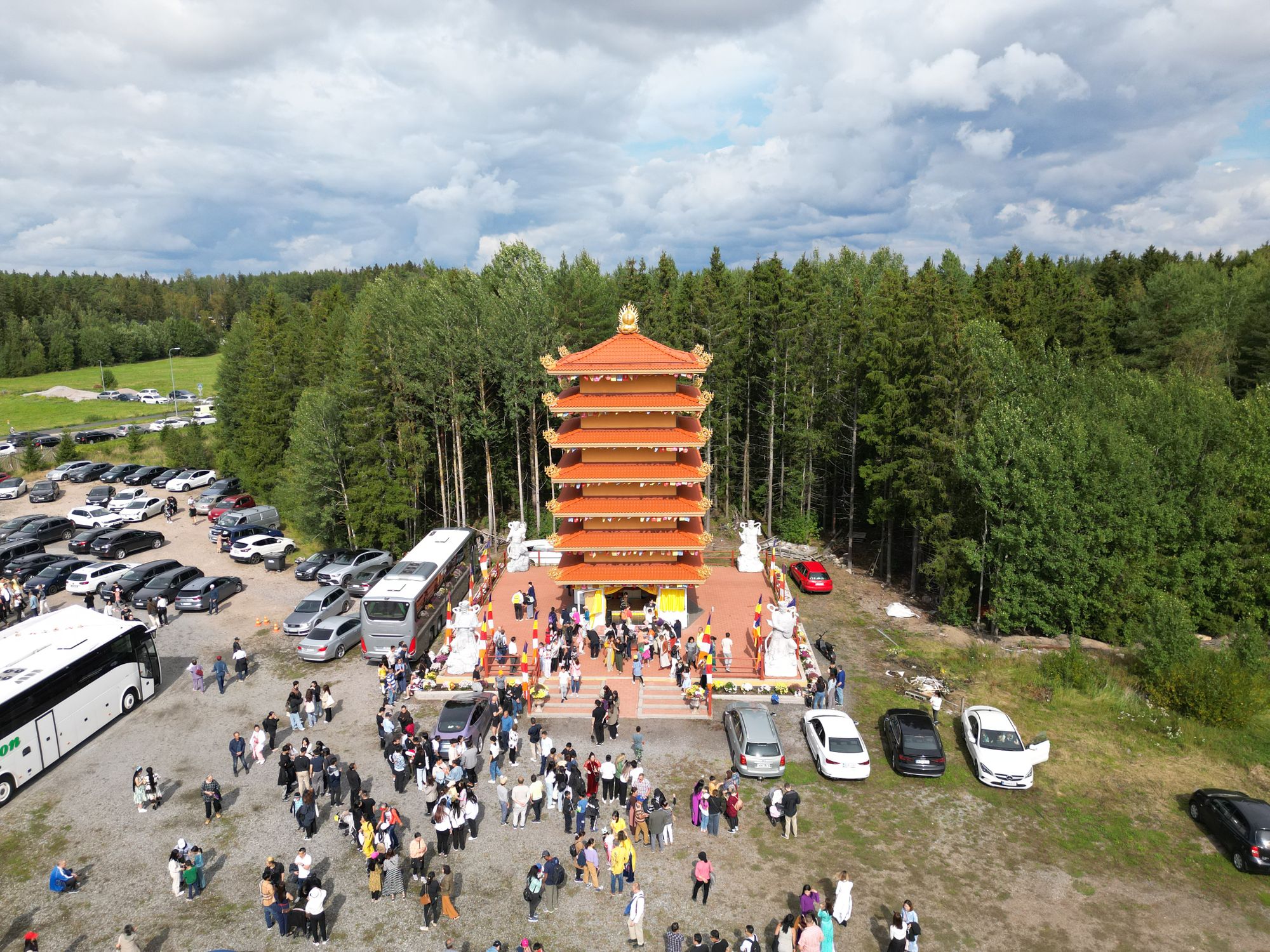
One of the most distinctive structures at Liên Tâm Buddhist Monastery is Tháp Địa Tạng, or the Kṣitigarbha Pagoda.
With its seven levels, traditional East Asian rooflines and four guardian statues, the pagoda is both an architectural landmark and a place filled with Buddhist symbolism.
The name refers to Kṣitigarbha Bodhisattva, known in Vietnamese as Địa Tạng Bồ Tát.
Kṣitigarbha is one of the great bodhisattvas of Mahāyāna Buddhism and is especially associated with great vows, compassion and the determination to help beings who are suffering.
A bodhisattva is someone who follows the path toward awakening while making the aspiration to help other beings become free from suffering.
At the top of Tháp Địa Tạng is a flaming precious jewel. The jewel is also closely associated with Kṣitigarbha, who is traditionally depicted carrying a luminous wish-fulfilling jewel.
Inside Tháp Địa Tạng, a statue of Śākyamuni Buddha is placed at the centre.
Śākyamuni Buddha is the historical Buddha, Siddhārtha Gautama, whose awakening and teachings form the foundation of the Buddhist tradition.
Visitors may hear Buddhist towers described using both the words stupa and pagoda.
These two architectural traditions are historically connected.
The stupa originated in ancient India. Early stupas were sacred Buddhist monuments, often constructed to preserve relics of the Buddha or important Buddhist teachers and to serve as places of remembrance and devotion.
As Buddhism spread from India into Central Asia and East Asia, Buddhist architecture gradually changed.
In China, Vietnam, Korea and Japan, the original rounded form of the Indian stupa developed into a tall tower with multiple levels and projecting roofs.
In English, this East Asian form is normally called a pagoda.
The Vietnamese word “tháp” can refer to this Buddhist tower tradition.
Tháp Địa Tạng at Liên Tâm therefore belongs to the long architectural development of Buddhist stupas and pagodas across Asia.
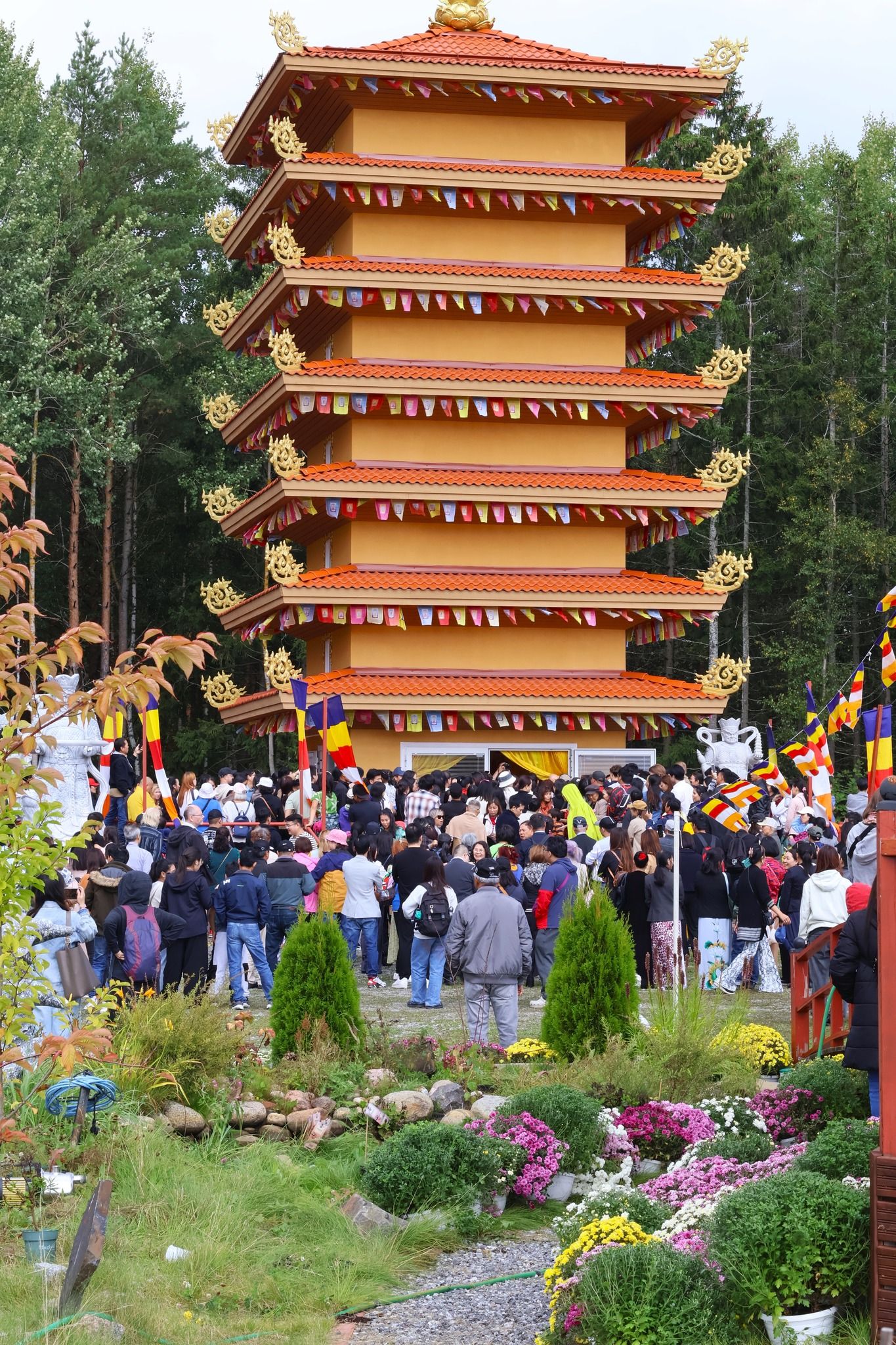
Tháp Địa Tạng has seven storeys.
Multi-storey pagodas are an important feature of East Asian Buddhist architecture. Different traditions and historical periods have built pagodas with different numbers of levels, including five, seven, nine and thirteen.
We may also contemplate its upward form symbolically.
From the ground, our eyes naturally move upward through one level after another.
Buddhist practice also develops gradually.
Understanding does not usually appear all at once.
A practitioner cultivates mindfulness, ethical conduct, concentration, compassion and wisdom step by step.
In this sense, the rising levels of the pagoda can remind us that spiritual cultivation is a journey rather than a single achievement.
At the four corners of Tháp Địa Tạng stand the imposing figures of the Four Heavenly Kings, known in Vietnamese as Tứ Đại Thiên Vương.
The Four Heavenly Kings are ancient Buddhist guardian figures associated with the four directions of the world.
In East Asian Buddhism they are commonly represented as:
They are traditionally regarded as protectors of the Buddhist teachings and of places where the Dharma is practised.
In East Asian Buddhist art, each Heavenly King also carries a distinctive object.
At Liên Tâm, these objects can be contemplated not only as traditional religious symbols, but also as teachings about our own minds and our own practice.
Tăng Trưởng Thiên Vương, Guardian King of the South, carries a sword.
The sword can be understood as the sword of wisdom.
In Buddhism, ignorance does not simply mean lacking education or information.
The Buddhist concept of ignorance — avidyā — refers more deeply to our inability to see reality clearly.
We mistake things that constantly change for something permanent.
We become attached to our ideas, possessions and identities.
We react to experiences through anger, fear, desire and habit before seeing them clearly.
Wisdom cuts through this confusion.
Just as a sharp sword separates one thing from another, wisdom helps us distinguish between what leads toward suffering and what leads away from suffering.
The sword is therefore not primarily a weapon directed at another person.
Its true target is ignorance within ourselves.
It reminds us:
Do not fight other people. Cut through your own confusion.
Before reacting in anger, look carefully.
Before believing every thought that appears in the mind, examine it.
Before acting from fear or desire, consider where that action will lead.
The real strength represented by the sword is the courage to see clearly.
Trì Quốc Thiên Vương, Guardian King of the East, holds a traditional stringed instrument.
The instrument offers a beautiful image for understanding one of the Buddha's central teachings: the Middle Way.
Imagine the strings of a musical instrument.
If a string is pulled too tightly, it can break.
If it is too loose, it cannot produce the correct sound.
Only when the tension is properly balanced can beautiful music appear.
Buddhist practice is similar.
If we force ourselves too harshly, practice may become tension, frustration and exhaustion.
If we make no effort, there can be little development.
A practitioner therefore learns to find the right balance.
The same principle applies far beyond meditation.
Work should be balanced with rest.
Discipline should be balanced with gentleness.
Speaking should be balanced with silence.
Effort should be balanced with letting go.
Even during meditation, we learn to be:
alert, but not tense;
relaxed, but not careless;
disciplined, but not forceful.
The instrument therefore invites us to ask ourselves:
Are the strings of my own life too tight, too loose, or in balance?
This is the spirit of the Middle Way.
Đa Văn Thiên Vương, Guardian King of the North, is traditionally depicted carrying a parasol or sacred umbrella.
An umbrella protects whoever stands beneath it from rain and the heat of the sun.
In the same way, the parasol can be contemplated as a symbol of protection.
The Four Heavenly Kings are traditionally regarded as protectors of the Dharma — the teachings of the Buddha.
But protecting the Dharma does not simply mean protecting monasteries, statues, books or ceremonies.
The Dharma survives when people actually live according to it.
When we choose kindness instead of cruelty, we protect the Dharma.
When we speak truthfully instead of deceiving others, we protect the Dharma.
When we remain mindful instead of acting carelessly, we protect the Dharma.
When we preserve compassion during difficult situations, the Buddha's teaching remains alive.
The parasol therefore reminds us to protect not only something outside ourselves, but also the wholesome qualities developing within our own minds.
A moment of anger can quickly destroy peace.
A careless word can damage a relationship.
A selfish action can undo much good work.
Just as we carefully hold an umbrella over something precious, Buddhist practice asks us to guard the mind and protect what is wholesome.
Perhaps the most striking of the Four Heavenly Kings is Quảng Mục Thiên Vương, Guardian King of the West.
He is traditionally depicted holding a dragon or serpent, sometimes together with a precious jewel.
From a Zen perspective, this image can become a powerful teaching about meditation and the mind.
The dragon can represent the powerful and difficult-to-control forces within us.
Thoughts appear constantly.
Desires arise.
Old memories suddenly return.
Anger can appear.
Fear can take over.
Excitement can make us lose awareness.
One thought leads to another, and before we realize what has happened, the mind has carried us far away.
It can be like being dragged by a powerful dragon.
Meditation does not mean killing the dragon.
Nor does it mean trying violently to suppress every thought and emotion.
Instead, Buddhist practice teaches us to recognize the dragon and learn how to hold it steadily.
When anger arises, know:
“Anger is present.”
When fear appears, recognize:
“Fear is present.”
When desire arises, see it clearly without immediately following it.
When thoughts become chaotic, return to awareness.
Little by little, we learn not to be controlled by everything that appears in the mind.
The dragon remains powerful, but we are no longer being dragged behind it.
The precious jewel can represent wisdom, awakening or the clear nature of the mind.
Everyone wants the jewel.
But Buddhist practice tells us that we cannot simply reach for the treasure while allowing the dragon to carry us wherever it wishes.
First, we must learn how to work with the mind.
In this contemplative interpretation:
to reach the precious jewel, we must first learn to hold the dragon.
This idea closely resembles a famous Zen verse attributed to Zen Master Huangbo – Thiền sư Hoàng Bá:
Trần lao quýnh thoát sự phi thường
Hệ bả thằng đầu tố nhất trường
Bất thị nhất phiên hàn triệt cốt
Tranh đắc mai hoa phốc tỷ hương
It may be understood approximately as:
To escape the dust of worldly confusion is no ordinary task;
one must grasp the rope firmly and practise with determination.
Without enduring the winter cold that penetrates to the bone,
how could one experience the fragrance of the plum blossom?
The image of grasping the rope firmly is important.
The mind is powerful.
If we follow every thought, every desire and every emotion that appears, they pull us in many directions.
Meditation teaches us to hold the rope.
To remain aware.
To remain steady.
To know clearly what is happening within us without immediately becoming controlled by it.
The plum blossom gives us another image.
It blossoms after surviving the cold winter.
In the same way, wisdom usually does not arise without patience, discipline, perseverance and practice.
The dragon and the precious jewel therefore offer a simple lesson:
Do not run away from the mind.
Learn to understand it.
Learn to hold it steadily.
Then wisdom can appear.