Vu lan 2025 - xe bus
👉 Mẫu đăng ký ở cuối trang này (link đã đóng) Tu viện Liên Tâm có
The Chánh Điện, or Main Hall, is the spiritual heart of Liên Tâm Buddhist Monastery.
This is where the monastic community and Buddhist practitioners gather for meditation, chanting, sutra recitation, Dharma teachings, retreats and important Buddhist ceremonies.
For visitors, the Chánh Điện is also a place where Buddhist teachings and philosophy can be understood through its statues, altars and symbolic arrangement.
At the central altar are three principal figures:
Quan Âm Bồ Tát — Avalokiteśvara Bodhisattva
Đức Phật Thích Ca Mâu Ni — Śākyamuni Buddha
Địa Tạng Bồ Tát — Kṣitigarbha Bodhisattva
In front of them are the Seven Medicine Buddhas, while two Dharma Protectors stand to the sides.
On the left side of the hall is an altar commemorating those who have passed away. On the right is an altar dedicated to the late Most Venerable Thích Minh Tâm.
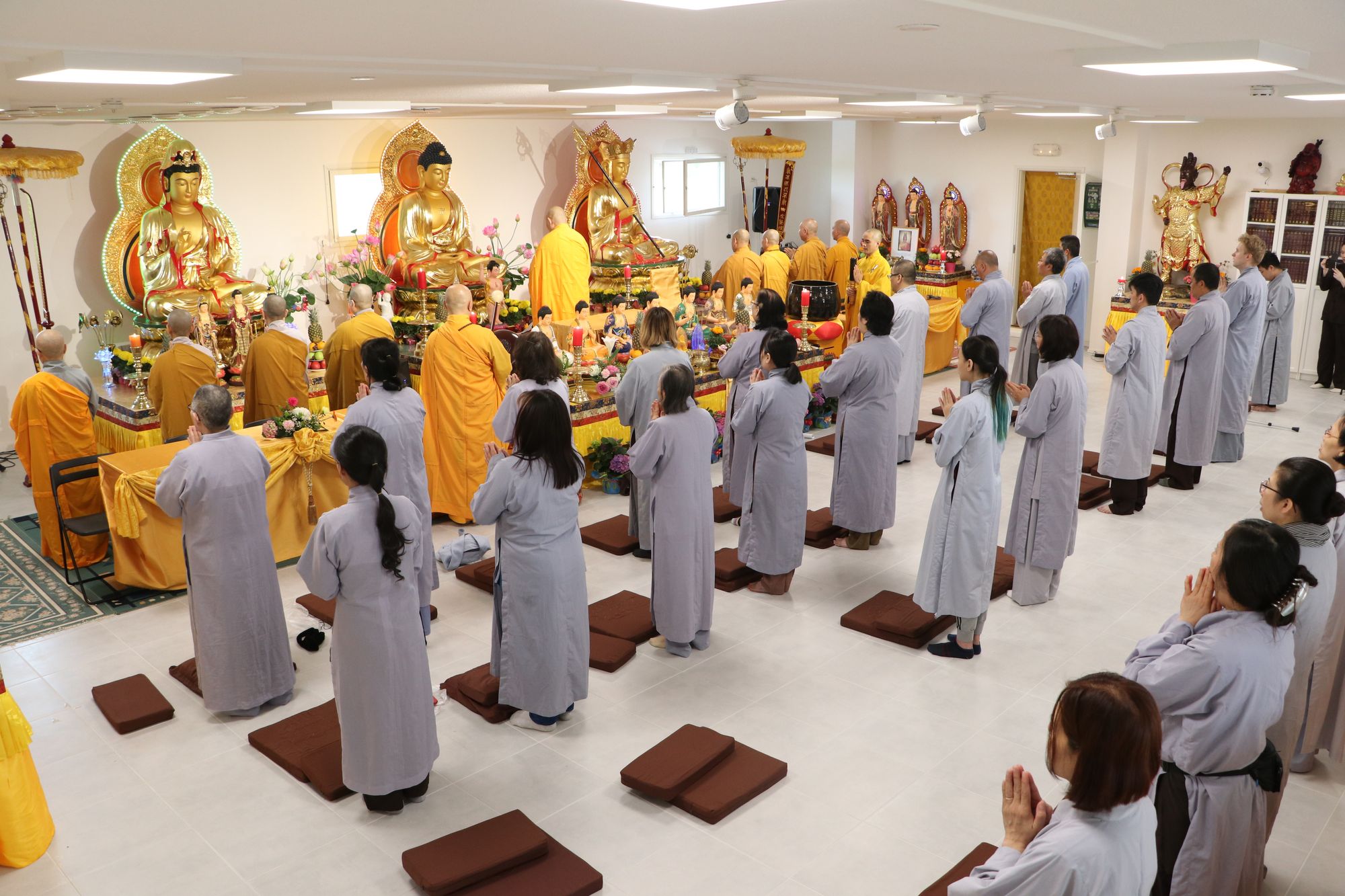
The three principal statues can be contemplated as expressing three essential dimensions of Buddhist practice:
awakening, compassion and great aspiration.
They are not simply three sacred figures from whom Buddhists ask for blessings. Each represents qualities that practitioners themselves seek to cultivate.
At the centre is Śākyamuni Buddha, the historical Buddha, Siddhārtha Gautama.
The word Buddha means “the Awakened One.”
His statue reminds us that the purpose of Buddhist practice is awakening: to see ourselves and the world more clearly, to understand the causes of suffering, and to become free from ignorance, craving and hatred.
The Buddha did not teach that liberation comes simply from worshipping him. He taught a path that must be understood, practised and experienced.
When we look at the peaceful figure of Śākyamuni Buddha, we can therefore ask:
Can I see this moment clearly, rather than only through my desires, fears and habits?
The Buddha represents what becomes possible when the mind awakens.
Quan Âm, or Avalokiteśvara, represents great compassion.
His Vietnamese name, Quan Thế Âm, is traditionally understood as the one who perceives or listens to the sounds of the world — especially the cries of beings who are suffering.
This makes Quan Âm more than an image of kindness.
He represents the ability to notice suffering and respond to it.
It is easy to say that we are compassionate when everything is peaceful.
The practice becomes more difficult when someone annoys us, disagrees with us or behaves badly toward us.
Quan Âm asks us to listen more deeply.
Perhaps there is fear behind someone’s anger.
Perhaps there is loneliness behind difficult behaviour.
Perhaps another person is carrying a suffering that we cannot see.
Compassion does not mean accepting harmful behaviour or agreeing with everyone. It means trying not to lose our capacity to understand and care.
The statue therefore reminds us:
Hear before judging.
Understand before reacting.
Help when you can.
Địa Tạng Bồ Tát, or Kṣitigarbha Bodhisattva, represents another dimension of the Bodhisattva path:
the strength to remain with beings even in the places of greatest suffering.
Kṣitigarbha is especially associated with beings in difficult states of existence and with an extraordinary vow not to abandon those who suffer.
There is an important difference between simply feeling compassion and making a vow.
We may feel compassion today and forget it tomorrow.
A vow gives compassion direction and endurance.
It means:
“Even when this becomes difficult, I will continue.”
Địa Tạng therefore represents steadfastness.
When other beings are difficult to help, do we turn away?
When practice becomes difficult, do we give up?
When compassion becomes inconvenient, does it disappear?
The Bodhisattva’s vow teaches us to remain.
Seen together, the three central figures offer a simple map of Buddhist practice.
Śākyamuni Buddha reminds us to awaken.
Without wisdom, we cannot see clearly.
Quan Âm reminds us to care.
Wisdom without compassion can become cold and detached.
Địa Tạng reminds us to continue.
Compassion without determination may disappear when circumstances become difficult.
So we need all three:
the wisdom to understand,
the compassion to respond,
and the determination to continue.
In front of the main altar are the Seven Medicine Buddhas — Thất Phật Dược Sư.
Visitors sometimes ask:
Why are there seven Medicine Buddhas instead of only one?
The best-known is Dược Sư Lưu Ly Quang Như Lai — Bhaiṣajyaguru, commonly known as the Medicine Buddha.
However, Mahāyāna Buddhist tradition also speaks of seven Buddhas associated with healing, compassionate vows and liberation from suffering.
So the seven statues are not simply seven copies of the same Buddha.
They represent seven awakened beings whose vows are associated with helping sentient beings overcome illness, suffering, fear, karmic obstacles and confusion.
In Buddhism, “healing” also has a meaning much broader than physical medicine.
There is illness of the body.
But there is also illness of the mind:
anger,
greed,
jealousy,
fear,
hatred,
confusion,
and attachment.
A physician treats illnesses of the body.
The Buddha is sometimes compared to a great physician of the mind, showing us suffering, its causes, the possibility of ending it, and the path of practice.
As you look at the Seven Medicine Buddhas, notice their hands.
Their different hand positions are called mudrās.
A mudrā is a symbolic gesture used in Buddhist art and practice. A hand gesture may express meditation, fearlessness, generosity, teaching or another spiritual quality without using words.
The exact hand positions of the Seven Medicine Buddhas can vary between different Buddhist artistic traditions.
But their gestures can generally be contemplated through several important meanings: The Gesture of Fearlessness, The Gesture of Giving, The Meditation Mudrā, The Teaching Mudrā, etc.
The best-known Medicine Buddha is often depicted with one hand in a gesture of giving or healing and the other holding a medicine bowl.
He may also hold a medicinal plant.
The symbolism is direct:
suffering is recognized,
its causes are understood,
and medicine is offered.
The deeper Buddhist meaning is that wisdom and compassion are themselves forms of medicine.
Standing before the Seven Medicine Buddhas, it is natural to think about physical health.
Good health is certainly important.
But Buddhism asks a deeper question:
What if the body is healthy but the mind is consumed by anger?
A person may be physically strong and still suffer terribly from jealousy.
Someone may possess great wealth and still never feel satisfied.
Another person may live comfortably but remain constantly afraid of losing what they have.
So Buddhist healing ultimately reaches deeper than the body.
The most profound disease is ignorance — not seeing reality clearly.
Its symptoms appear as greed, hatred and delusion.
The ultimate medicine is wisdom.
The Seven Medicine Buddhas therefore remind us to care for both:
the body that carries us through life,
and the mind through which we experience life.
On the two sides of the Chánh Điện stand two very different guardian figures.
One has a more dignified, benevolent and heavenly appearance.
The other has a fierce appearance, almost like a hungry ghost or demonic being.
At first this contrast can seem surprising.
Why would a peaceful Buddhist hall contain such a frightening figure?
Because Buddhist compassion does not always have only one form.
Sometimes compassion is gentle.
Sometimes compassion must be strong.
The benevolent guardian can represent Khuyến Thiện — encouraging goodness.
Its dignified celestial appearance can remind us of the beneficial results of wholesome actions.
When we practise generosity, honesty and kindness, something changes.
When we cultivate patience, the world around us may not immediately change — but our relationship with it changes.
When we stop harming others, suffering is reduced.
When we help others, goodness spreads beyond ourselves.
The heavenly appearance can therefore symbolize the beautiful consequences of wholesome conduct.
But Buddhism adds an important point.
Even a heavenly existence is still not the final goal.
Pleasure, beauty and fortunate circumstances are also impermanent.
So the teaching is not simply:
“Be good and you will receive rewards.”
It goes deeper:
Develop goodness because it purifies the mind and prepares the way for wisdom.
The guardian encourages us forward.
The other guardian looks almost frightening.
Its appearance may remind visitors of a demon or a being from the hungry-ghost realm.
But we should not conclude:
“This statue represents evil.”
In Mahāyāna Buddhist art, a fierce appearance can represent protective compassion.
Sometimes compassion comforts.
Sometimes compassion must stop something harmful.
A parent may gently comfort a crying child.
But the same parent may immediately pull that child away from a dangerous road.
The motivation is the same:
compassion.
The method is different.
The fierce guardian therefore represents the principle of restraining what is harmful.
The hungry-ghost-like appearance also offers a powerful philosophical image.
In Buddhist cosmology, the hungry ghost — preta is characterized by intense craving that can never truly be satisfied.
This can also be understood psychologically.
We do not need to become literal ghosts to experience the mind of a hungry ghost.
We may think:
One more possession will make me happy.
Then we obtain it.
Soon we want something else.
We want more money.
More attention.
More praise.
More status.
More entertainment.
More recognition.
The object changes.
The hunger remains.
This is the hungry mind.
From this perspective, the frightening guardian outside us also points toward something inside us.
What needs to be subdued?
Not another person.
Our own greed.
Our own hatred.
Our own delusion.
The two guardians represent two complementary methods.
Sometimes a person develops through encouragement.
Show them what is wholesome.
Give them an example.
Support them.
Help goodness grow.
This is Khuyến Thiện.
But sometimes something harmful must be stopped.
A destructive habit may require discipline.
Anger may need to be restrained before it becomes harmful speech.
Greed may require a clear boundary.
An action causing suffering may require us to say:
“No. Stop.”
The two guardians therefore should not be understood simply as:
one good being and one evil being.
Both stand on the side of the Dharma.
One protects through encouragement.
The other protects through restraint.
Together they express an important Buddhist principle:
True compassion needs both gentleness and strength.
On the left side of the Chánh Điện is the memorial altar for the deceased — bàn thờ vong. This is part of Vietnamese culture, and in East Asian culture.
Photographs or names of deceased relatives and members of the community may be placed here so that they can be remembered during Buddhist services.
This altar is connected with remembrance, gratitude toward parents and ancestors, and contemplation of impermanence — vô thường.
It reminds us of something every human being shares.
We are born.
We grow older.
We become ill.
Eventually, we die.
Remembering death in Buddhism is not intended to make life gloomy.
It makes life precious.
If we truly understood that our parents would not always be here, perhaps we would speak to them differently.
If we understood that our own time was limited, perhaps some arguments would no longer seem so important.
If we realized that everyone around us is also subject to ageing and death, perhaps we would become a little more compassionate.
The memorial altar therefore faces us with a simple question:
Knowing that life does not last forever, how should we live today?
On the right side of the hall is an altar dedicated to the late Most Venerable Thích Minh Tâm.
He was an important figure in Vietnamese Buddhism in Europe and served as Chairman of the Executive Council of the Unified Vietnamese Buddhist Church in Europe.
He was also closely associated with Khánh Anh Temple in France and spent many decades supporting the development of Vietnamese Buddhism in Europe.
In 2013, he came to Finland in connection with the European Vietnamese Buddhist retreat held in Turku.
During this period, his health declined.
Most Venerable Thích Minh Tâm passed away in Finland in 2013.
His passing in Finland created a particularly close historical connection between him and the Vietnamese Buddhist community here.
His altar at Liên Tâm therefore preserves the memory of a Buddhist teacher who played an important role in the development of Vietnamese Buddhism in Europe.
In Buddhist tradition, remembering a teacher is not merely remembering a personality.
The deeper question is:
What teaching did that person’s life leave behind?
Respect for a teacher becomes meaningful when the next generation continues to study and practise the Dharma.